Giving your dog the freedom to roam appeals to many – and for good reason. You’ll seldom find a dog that is displeased with their freedom to explore, run about and follow their nose. Many ask how to know when their dog is ready for such freedom. We applaud your desire to make the experience a safe and positive one for der you, your dog, and others in the area. In reviewing our suggested considerations, if you determine that your dog isn’t ready yet, we are happy to help and have included some tips to help in your preparations.
*Please note that this blog does not intend to substitute individualized training advice. For a specific plan for preparing or evaluating your pup’s readiness to go off-leash, please contact us.
The first question to ask yourself should be, “Is my dog ready?” The answer to that question may depend heavily on the where and the when of your intended adventure. Your dog may respond lightning fast to when you call her in your home and you are holding her favorite treat, but may not seem to hear you in a park full of scents to follow and activities to engage in. The greater the distraction level of the environment, the more difficult it will be for your dog to respond to your cue.
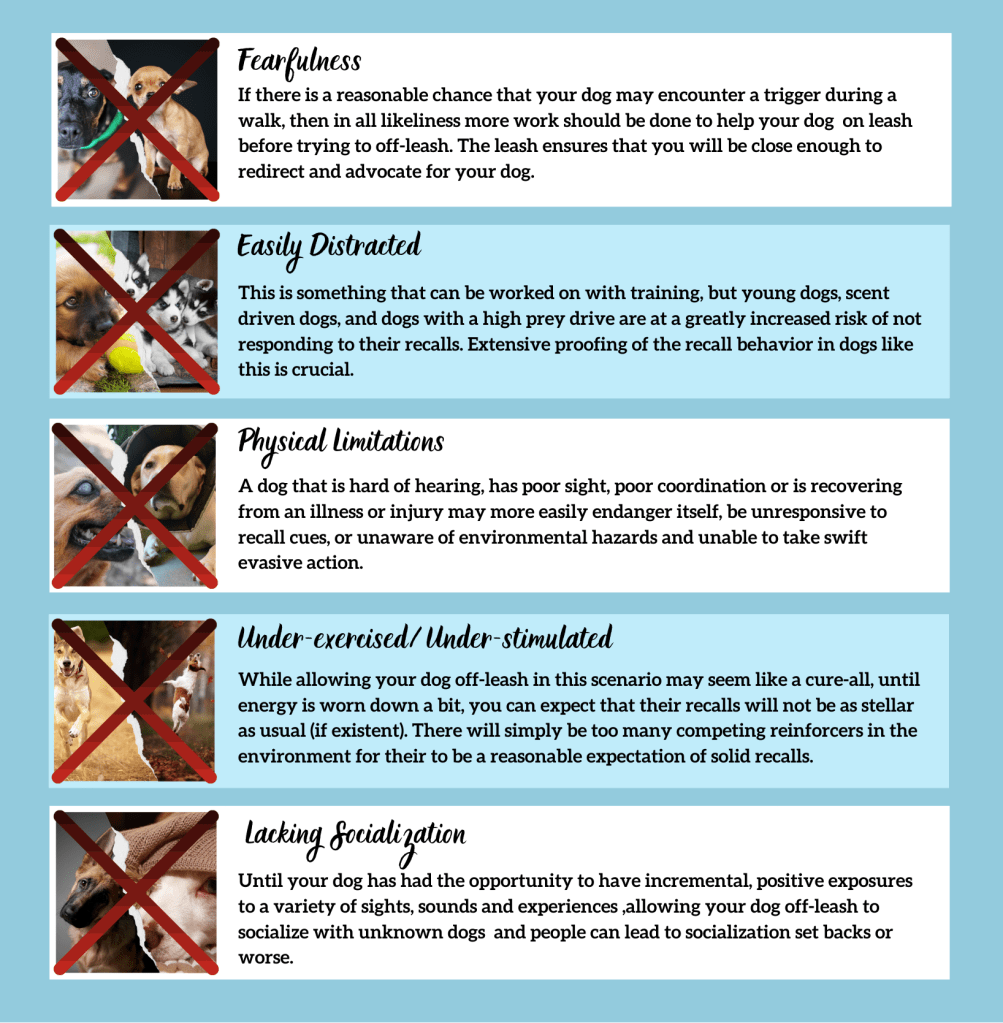
While certainly not the most fun part of the process, responsible dog parents are faced with evaluating if their dog is truly ready to go off-leash.
Signs that Your Dog Isn’t Ready to be Off-Leash:
Recall is the term used to describe cuing a dog to come back to you when called. This is a vital skill for dogs to learn, and it should be mastered for safe AND enjoyable off-leash fun. Putting in the work to build solid recalls is much better than finding out that that recalls are lacking as one comes across a skunk, nears a road, etc.
Solid Recalls are Essential for Safety:
So, how does one get those much desired solid recalls? The key to mastering recalls under distraction is taking baby steps by incrementally increasing the distraction level of the environment in which you ask your dog to recall. There should be lots of repetition so that your dog remains successful and that you build a very strong “reinforcement history” – that is, a long history of your dog successfully recalling to you when cued and being rewarded with high-value goodies for doing so. Coming when called must be a positive experience for your dog! You are asking him to leave something he has free access to and come to you instead; make sure your rewards measure up! A common mistake is to scold for a slow or non-existent re-call. A dog does not have the cognitive capacity to make the connection that they are being scolded for not coming right away. The connection will be, “Wow, when I come back, something bad happens“. So the dog will likely have increasingly slower recalls as the association between a recall cue and lack of reward build.

If your dog recalls promptly in one environment but is unable to in the next, you have taken a leap rather than a baby step; return to the last environment wherein your dog was successful, reinforce her recall generously, and when she’s ready to “level up,” choose a new training environment with a level of distraction that is in between the one wherein she was successful and the one wherein she was unsuccessful.
While working up to your ideal off leash scenario, ensure safeties are in place. Perhaps first practice recalls on a retractable leash or a long line.
Interested in talking more about your dog’s specific needs? Let’s collaborate & work towards your goals!
 Progressive Paws