Safe-guarding your pup: Off-leash Ready?

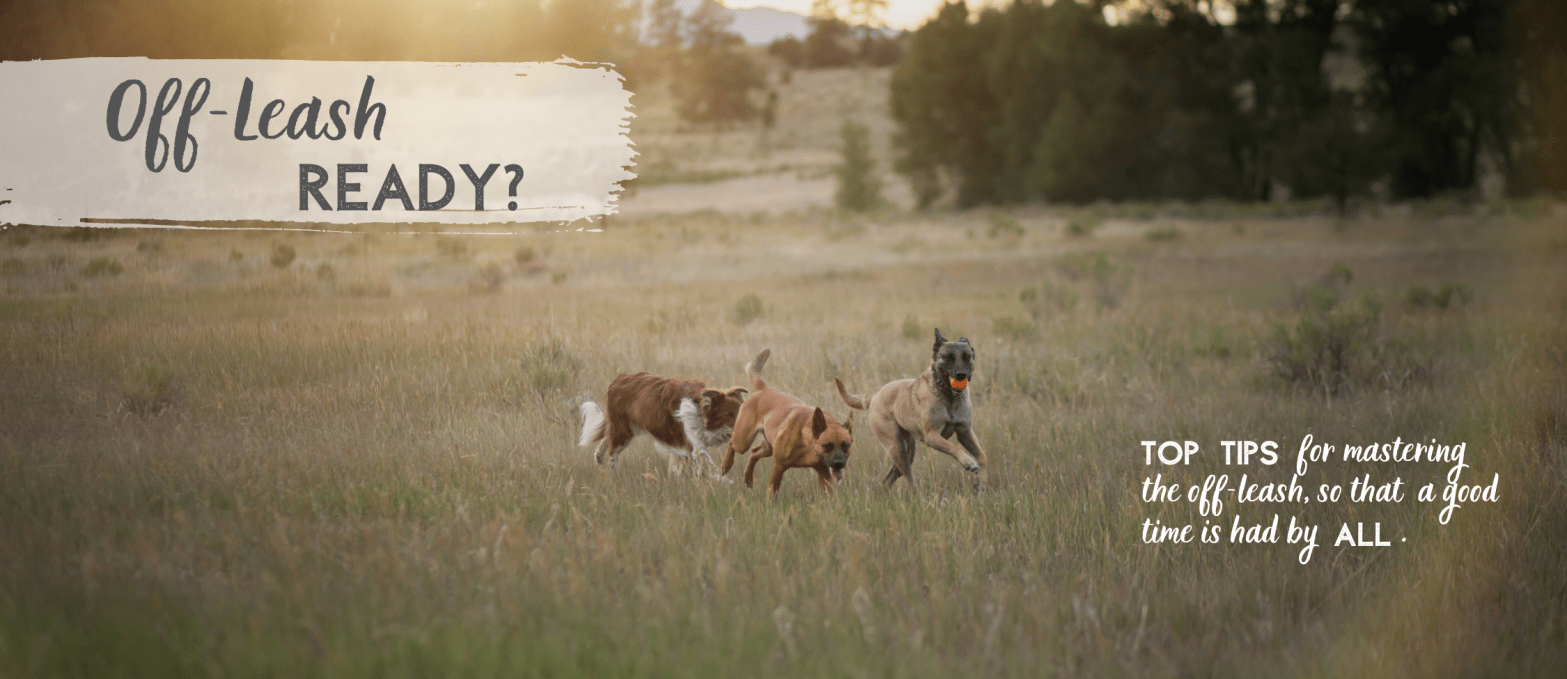
Giving your dog the freedom to roam appeals to many – and for good reason. You’ll seldom find a dog that is displeased with their freedom to explore, run about and follow their nose. Many ask how to know when their dog is ready for such freedom. We applaud your desire to make the experience a safe and positive one for der you, your dog, and others in the area. In reviewing our suggested considerations, if you determine that your dog isn’t ready yet, we are happy to help and have included some tips to help in your preparations.

*Please note that this blog does not intend to substitute individualized training advice. For a specific plan for preparing or evaluating your pup’s readiness to go off-leash, please contact us.

The first question to ask yourself should be, “Is my dog ready?” The answer to that question may depend heavily on the where and the when of your intended adventure. Your dog may respond lightning fast to when you call her in your home and you are holding her favorite treat, but may not seem to hear you in a park full of scents to follow and activities to engage in. The greater the distraction level of the environment, the more difficult it will be for your dog to respond to your cue.

While certainly not the most fun part of the process, responsible dog parents are faced with evaluating if their dog is truly ready to go off-leash.

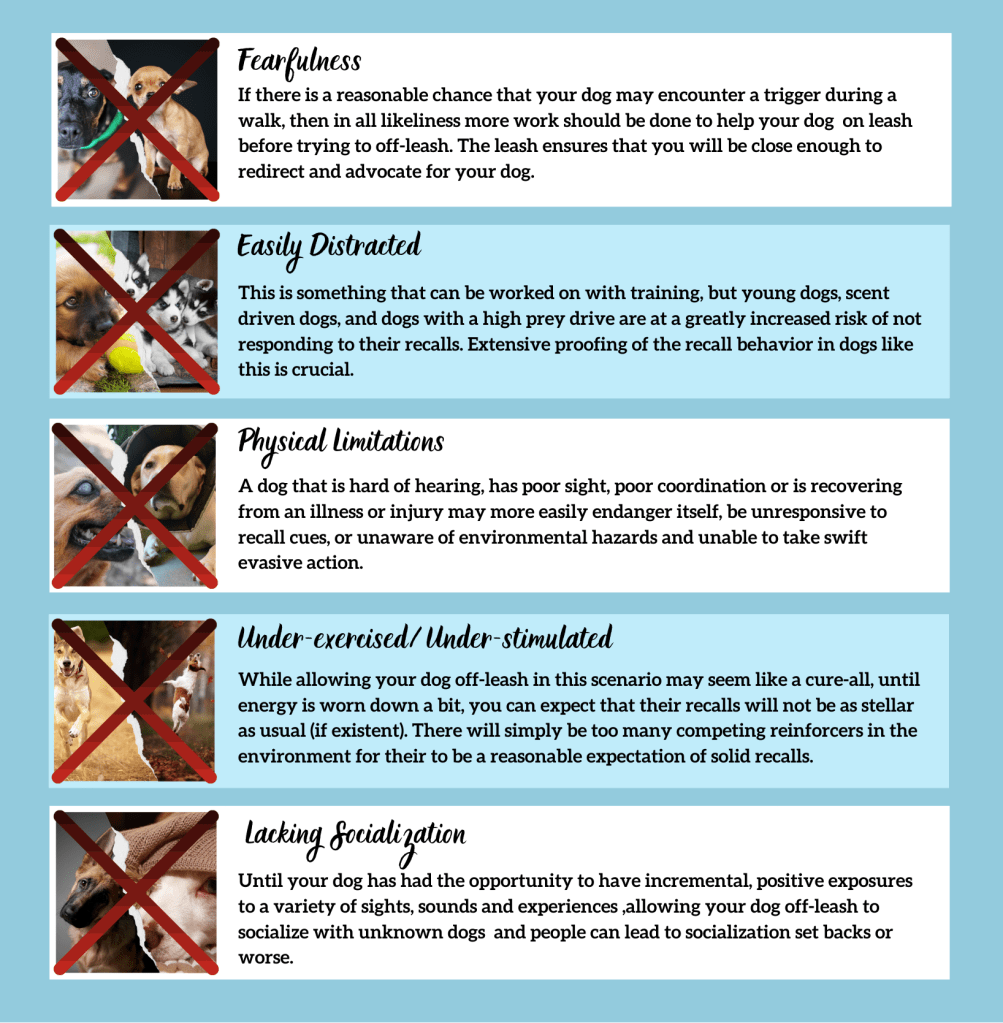
Signs that Your Dog Isn’t Ready to be Off-Leash:
Recall is the term used to describe cuing a dog to come back to you when called. This is a vital skill for dogs to learn, and it should be mastered for safe AND enjoyable off-leash fun. Putting in the work to build solid recalls is much better than finding out that that recalls are lacking as one comes across a skunk, nears a road, etc.

Solid Recalls are Essential for Safety:

So, how does one get those much desired solid recalls? The key to mastering recalls under distraction is taking baby steps by incrementally increasing the distraction level of the environment in which you ask your dog to recall. There should be lots of repetition so that your dog remains successful and that you build a very strong “reinforcement history” – that is, a long history of your dog successfully recalling to you when cued and being rewarded with high-value goodies for doing so. Coming when called must be a positive experience for your dog! You are asking him to leave something he has free access to and come to you instead; make sure your rewards measure up! A common mistake is to scold for a slow or non-existent re-call. A dog does not have the cognitive capacity to make the connection that they are being scolded for not coming right away. The connection will be, “Wow, when I come back, something bad happens“. So the dog will likely have increasingly slower recalls as the association between a recall cue and lack of reward build.

A plan for increasing your dog’s reliability recalling under distraction, should be incremental and have repetition with each new distraction added in. Depending on the dog and the ultimate off-leash goal, the steps may be far more complex than the sample plan.

If your dog recalls promptly in one environment but is unable to in the next, you have taken a leap rather than a baby step; return to the last environment wherein your dog was successful, reinforce her recall generously, and when she’s ready to “level up,” choose a new training environment with a level of distraction that is in between the one wherein she was successful and the one wherein she was unsuccessful.

While working up to your ideal off leash scenario, ensure safeties are in place. Perhaps first practice recalls on a retractable leash or a long line.

Interested in talking more about your dog’s specific needs? Let’s collaborate & work towards your goals!
Positive Reinforcement-the Science of Kindness

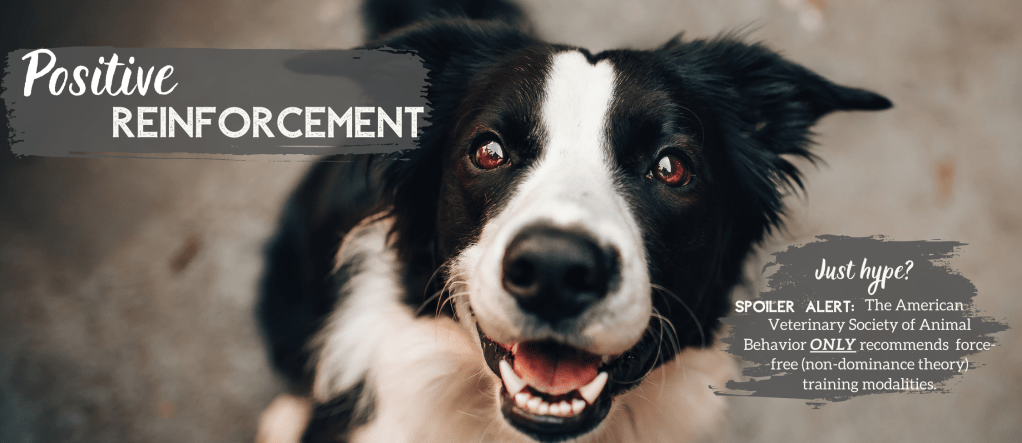
Positive reinforcement is a term that many dog guardians have heard of and chosen to incorporate in their dog training.

I will admit that I apprenticed under a dog trainer that promoted Dominance Theory, which is also referred to as Pack Order Theory. I am saddened that I also taught these concepts briefly, in my early days as a trainer. So, without drawing this out, I’ll highlight what positive reinforcement entails, why I switched, and address common misconceptions about positive reinforcement.

This blog is not aimed at guilting anyone that uses punitive methods. The hope for this blog is to shed some light on this narrative so that each individual may research and reflect on the methods they currently utilize. This is something I would have liked to have done differently myself when first starting out.

Positive reinforcement means that something pleasant is added to increase the recurrence of a behavior. For those of you looking to “nerd out” or take up dog sports: R+ is used to represent one of the four quadrants of operant conditioning, the R stands for reinforcement and + means that it is added. Positively reinforcement serves to increase the desired behavior.

In sitting down to write this, I struggled to concisely explain why I switched to positive reinforcement without going into the downfalls of Dominance Theory. In essence, I found the techniques commonly utilized by those practicing Dominance Theory are astoundingly ineffective for addressing fear-based behaviors as those methods increase anxiety. This led to a lot of research and thus to the conclusion that what I had been taught was not evidence-based and worse, is very capable of causing long-term damage to a dog; including dogs free from fear-based etiologies.

The Benefits of Positive Reinforcement and other Force-free Modalities:

Builds a relationship based on trust & care. By making training fun, a bond is formed and the dog is eager for training sessions. Just like humans, dogs learn more readily in the absence of excessive stress.

Positive Reinforcement does not create detrimental associations that positive punishment is prone to. Dogs exposed to aversives during training increases stress-even to the level that they are in fight or flight mode. Being frequently in fight or flight mode causes long-term stress which makes a dog highly prone to creating unintended and often harmful associations. For instance, a correction may be intended to stop a from pulling on a leash. However, the dog can easily associate the correction with anything else frequently encountered when a correction is given be it joggers, other dogs, etc..

Giving a dog a choice leads to better long-term results. I like to think of this as a ‘have to do’ mentality versus a ‘choose to do this’ mentality. The have to do mentality: have you ever been to a dog park and seen an owner call their dog, and the dog ignores them because “yeah, so much to smell!” In response, the owner increases volume yells, gruffly grabs the dog and both leave unhappily. So from the dog’s perspective: they both had to leave the dog park AND she received scolding for being around their owner. This is only going to slow down the dog coming back in the future. The chose to do mentality :  the dog is gradually worked into increasingly busier environments and rewarded for coming when called. This builds a reinforcement history with the cue and the dog associates that choice with lots of good things.

*When punitive methods including electric-collars (e-collars), collar pops, choke collars, prong collars, alpha-rolls, etc. are used to manage undesirable behavior, a dog is prone to go into fight or flight mode. Being frequently in fight or flight mode causes long-term stress, also making a dog highly prone to creating unintended and often harmful associations. For instance, a correction may be intended to stop a dog from pulling on leash. However, the dog can easily associate the correction with anything else frequently encountered when a correction is given be it joggers, dogs..

Thanks for taking the time to learn about my journey to evidence-based training! I hope that by sharing my journey, that others may also begin to seek out the joys of positive reinforcement.

Sources

1. American Veterinary Society of Animal Behavior. (2014, October 3). Position Statement on the Use of Dominance Theory in Behavior Modification of Animals. Retrieved from https://avsab.org/wp-content/uploads/2018/03/Dominance_Position_Statement_download-10-3-14.pdf

2. Ziv, G. (may-june 2017). The Effects of Using Aversive Training Methods in Dogs- A Review. Journal of Veterinary Behavior: Clinical Applications and Research, 19, 50-60.